ANSWERS
Does snoring get worse with age?
Usually, yes. The airway becomes floppier with age, and sleep apnea more common.
Why age matters
With age, the muscles and tissues of the throat lose some of their tone, and the reflexes that keep the airway open in sleep weaken. In 21 healthy adults, increasing age was strongly correlated with how easily the airway collapsed during sleep and how much resistance it put up, regardless of weight or sex 1. Weight often rises in middle age too, and in women, menopause adds to the effect 3.
The numbers follow. In US estimates, moderate to severe sleep-disordered breathing rises from 10% of men aged 30 to 49 to 17% of men aged 50 to 70, and from 3% to 9% of women 2.
What still helps
Age itself can't be changed, but the other factors can: side sleeping, less evening alcohol, a clear nose, mouth and throat exercises to tone the airway, and a mouthguard for persistent snoring.
Why do older people snore more?
The airway becomes more collapsible with age 1, and weight often rises in middle age.
At what age does snoring start?
It can start at any age. It becomes more common from middle age, and in women after menopause 3.
Can older people stop snoring?
Many can reduce it with the same remedies as younger people. Exercises that tone the throat may be especially worth trying.
Is snoring in older people dangerous?
Not on its own, but sleep apnea is more common with age and easier to miss 4, so daytime sleepiness is worth mentioning to a doctor.
Sources
- Eikermann M, Jordan AS, Chamberlin NL, et al. The influence of aging on pharyngeal collapsibility during sleep. Chest. 2007;131(6):1702-1709. doi.org/10.1378/chest.06-2653
- Peppard PE, Young T, Barnet JH, et al. Increased prevalence of sleep-disordered breathing in adults. Am J Epidemiol. 2013;177(9):1006-1014. doi.org/10.1093/aje/kws342
- Young T, Finn L, Austin D, Peterson A. Menopausal status and sleep-disordered breathing in the Wisconsin Sleep Cohort Study. Am J Respir Crit Care Med. 2003;167(9):1181-1185. doi.org/10.1164/rccm.200209-1055OC
- Young T, Shahar E, Nieto FJ, et al. Predictors of sleep-disordered breathing in community-dwelling adults: the Sleep Heart Health Study. Arch Intern Med. 2002;162(8):893-900. doi.org/10.1001/archinte.162.8.893
COMING SOON
Find out
how you snore.
Snores listens through the night on your iPhone and shows you in the morning how much and how loudly you snored, with clips of the loudest moments. Tag what you tried and see what goes with quieter nights. The sound stays on your iPhone.
Meet Snores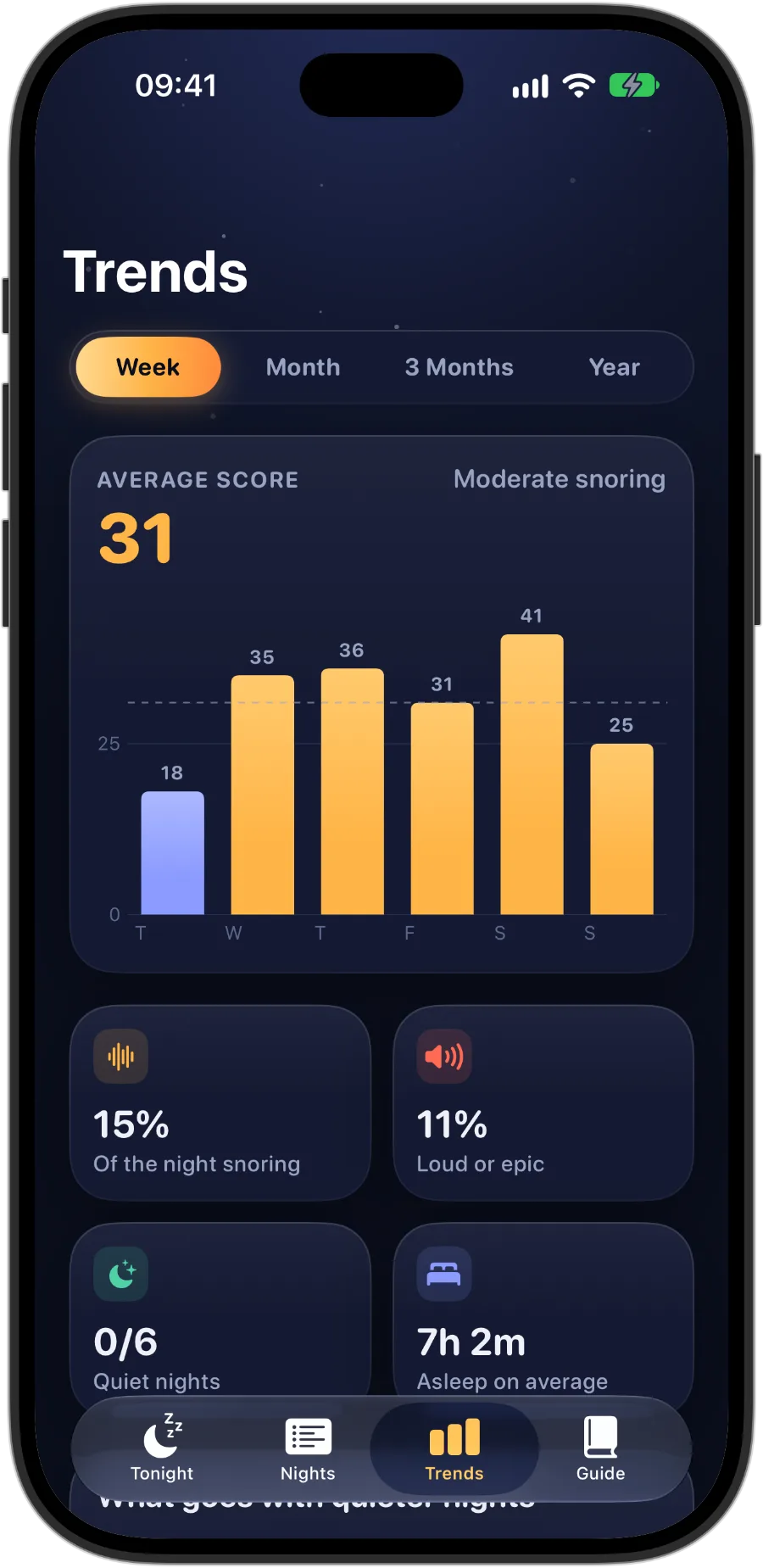
This page is general information, not medical advice. Snores is not a medical device and does not diagnose sleep apnea or any other condition. If you are worried about your sleep or your breathing, talk to a doctor.