REMEDIES
Anti-snore mouthguards
The device with the best evidence for snoring, especially when a dentist fits it.
- Best for
- Persistent snoring, and mild to moderate sleep apnea
- Evidence
- Strong: guidelines and randomized trials
- Cost
- Moderate for boil-and-bite, higher for custom-made
- Time to work
- Days to weeks to get used to it
How they work
A mandibular advancement device looks like a sports mouthguard for the upper and lower teeth. It holds the lower jaw, and with it the tongue, slightly forward during sleep. That widens the space behind the tongue and the soft palate, so the airway is less likely to narrow and vibrate.
- Mandibular advancement device (MAD)
- A mouthguard that holds the lower jaw forward. Also called a mandibular advancement splint or oral appliance.
- Custom-made
- Made by a dentist from impressions of your teeth, and usually adjustable.
- Boil-and-bite
- Softened in hot water and shaped by biting into it at home. Cheaper, often less comfortable.
- Tongue-retaining device
- A different device that holds the tongue forward by suction, without moving the jaw.
What the research found
A review for the UK's health technology program found that mandibular advancement splints improved objective measures of snoring, such as the loudest and average snoring volume and the share of time spent snoring loudly 2. Based on the evidence, US sleep medicine and dental sleep medicine academies recommend oral appliances for primary snoring in adults who want treatment 1.
For sleep apnea, a European Respiratory Society task force found that custom-made devices reduce breathing pauses and daytime sleepiness compared with placebo devices. CPAP reduces breathing pauses more, but many patients prefer a mouthguard, and they are recommended for mild to moderate sleep apnea and for people who can't tolerate CPAP 3.
Side effects
- Sore jaw or teeth, and too much or too little saliva, often in the first weeks.
- A change in how the teeth meet in the morning, which usually settles within minutes.
- Over years, small changes in the bite. That is why guidelines recommend follow-up with a dentist 1.
Good for
- Snoring that other remedies didn't fix
- Mild to moderate sleep apnea, with a doctor
- Travel: small and silent
Watch out for
- Jaw or tooth discomfort
- Cost of a custom device
- Needs enough healthy teeth
Do anti-snoring mouthguards really work?
Yes, for many people. They are recommended by sleep medicine guidelines for snoring 1 and improved objective snoring measures in studies 2.
Are anti-snoring mouthguards safe?
Generally, yes. Jaw and tooth soreness is common at first, and long-term use can change the bite slightly, so dental follow-up is recommended 1.
Is a custom mouthguard worth it?
For sleep apnea, guidelines prefer custom, adjustable devices 1. For simple snoring, a boil-and-bite device is a reasonable way to find out whether the approach suits you.
Can I use a mouthguard if I have sleep apnea?
Yes, with a doctor's diagnosis and follow-up. They are recommended for mild to moderate sleep apnea and for people who can't tolerate CPAP 3.
Sources
- Ramar K, Dort LC, Katz SG, et al. Clinical practice guideline for the treatment of obstructive sleep apnea and snoring with oral appliance therapy: an update for 2015. J Clin Sleep Med. 2015;11(7):773-827. doi.org/10.5664/jcsm.4858
- Main C, Liu Z, Welch K, Weiner G, Jones SQ, Stein K. Surgical procedures and non-surgical devices for the management of non-apnoeic snoring: a systematic review of clinical effects and associated treatment costs. Health Technol Assess. 2009;13(3):1-208. doi.org/10.3310/hta13030
- Marklund M, Verbraecken J, Randerath W. Non-CPAP therapies in obstructive sleep apnoea: mandibular advancement device therapy. Eur Respir J. 2012;39(5):1241-1247. doi.org/10.1183/09031936.00144711
COMING SOON
Find out
how you snore.
Snores listens through the night on your iPhone and shows you in the morning how much and how loudly you snored, with clips of the loudest moments. Tag what you tried and see what goes with quieter nights. The sound stays on your iPhone.
Meet Snores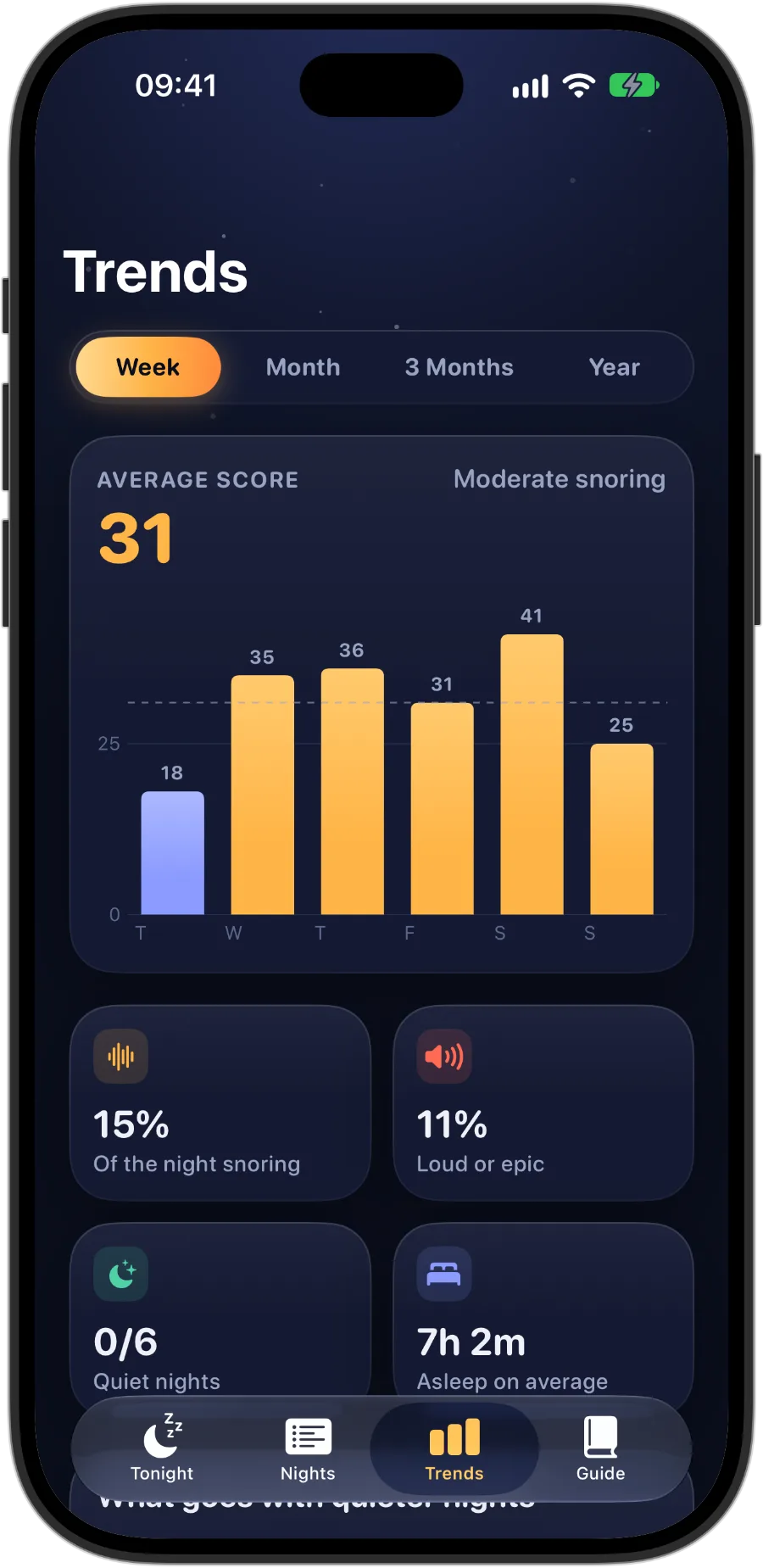
This page is general information, not medical advice. Snores is not a medical device and does not diagnose sleep apnea or any other condition. If you are worried about your sleep or your breathing, talk to a doctor.