SNORING
Snoring in women
Why snoring often starts in pregnancy or after menopause, and why sleep apnea in women is easy to miss.
Why women snore less, until they don't
Before middle age, women are less likely than men to snore and to have sleep apnea. In a study of more than 1,700 adults tested in a sleep lab, men had clinically defined sleep apnea about three times as often as women 4. Female hormones, particularly progesterone, are thought to help keep the throat muscles toned and breathing steady, and women tend to carry less fat around the neck.
After menopause
That protection fades with menopause. In the Wisconsin Sleep Cohort, postmenopausal women were 2.6 times more likely to have at least mild sleep-disordered breathing and 3.5 times more likely to have moderate or worse than premenopausal women, after allowing for age, body size and smoking 1. In the Pennsylvania study, sleep apnea was rare in premenopausal women (0.6%) but more common in postmenopausal women not taking hormone therapy (2.7%) 4.
In pregnancy
Pregnancy brings weight gain, swelling of the lining of the nose and pressure from the growing baby, all of which can narrow the airway. In a study of 105 pregnant women who had sleep tests in the first and third trimesters, the share with obstructive sleep apnea rose from 10.5% to 26.7%. Higher weight and age at the start of pregnancy were the main risk factors 2.
Key study
Sleep apnea and complications of pregnancy
- 3,705 women
- First pregnancies
- Home sleep tests
Women in their first pregnancy had home sleep tests in early and mid-pregnancy. Sleep-disordered breathing affected 3.6% early and 8.3% by mid-pregnancy. Women with it had about twice the odds of preeclampsia and about three times the odds of gestational diabetes, after accounting for other risk factors.
Why sleep apnea in women is often missed
Women with sleep apnea often describe it differently: tiredness, insomnia, morning headaches or low mood rather than loud snoring and gasping. In one study, researchers estimated that 93% of women with moderate to severe sleep apnea had never been diagnosed, compared with 82% of men 3. If you are a woman and you snore and feel tired, it is worth asking about a sleep test.
Why do women start snoring after menopause?
The fall in female hormones is thought to make the throat muscles less toned. After menopause, women are more likely to have sleep-disordered breathing, regardless of age and weight 1.
Is it normal to snore in pregnancy?
It is common, especially in the third trimester, as weight, a stuffy nose and pressure on the lungs increase. Sleep apnea also becomes more common 2, so mention loud snoring to your midwife or doctor.
Does snoring in pregnancy harm the baby?
Simple snoring isn't known to. Sleep-disordered breathing in pregnancy has been linked with preeclampsia and gestational diabetes 5, which is why it is worth raising with your midwife or doctor.
Do women snore as loudly as men?
On average, women snore less loudly. In a sleep lab study of more than 1,100 people, average snoring was louder in men 6.
Sources
- Young T, Finn L, Austin D, Peterson A. Menopausal status and sleep-disordered breathing in the Wisconsin Sleep Cohort Study. Am J Respir Crit Care Med. 2003;167(9):1181-1185. doi.org/10.1164/rccm.200209-1055OC
- Pien GW, Pack AI, Jackson N, et al. Risk factors for sleep-disordered breathing in pregnancy. Thorax. 2014;69(4):371-377. doi.org/10.1136/thoraxjnl-2012-202718
- Young T, Evans L, Finn L, Palta M. Estimation of the clinically diagnosed proportion of sleep apnea syndrome in middle-aged men and women. Sleep. 1997;20(9):705-706. doi.org/10.1093/sleep/20.9.705
- Bixler EO, Vgontzas AN, Lin HM, et al. Prevalence of sleep-disordered breathing in women: effects of gender. Am J Respir Crit Care Med. 2001;163(3):608-613. doi.org/10.1164/ajrccm.163.3.9911064
- Facco FL, Parker CB, Reddy UM, et al. Association between sleep-disordered breathing and hypertensive disorders of pregnancy and gestational diabetes mellitus. Obstet Gynecol. 2017;129(1):31-41. doi.org/10.1097/AOG.0000000000001805
- Wilson K, Stoohs RA, Mulrooney TF, et al. The snoring spectrum: acoustic assessment of snoring sound intensity in 1,139 individuals undergoing polysomnography. Chest. 1999;115(3):762-770. doi.org/10.1378/chest.115.3.762
COMING SOON
Find out
how you snore.
Snores listens through the night on your iPhone and shows you in the morning how much and how loudly you snored, with clips of the loudest moments. Tag what you tried and see what goes with quieter nights. The sound stays on your iPhone.
Meet Snores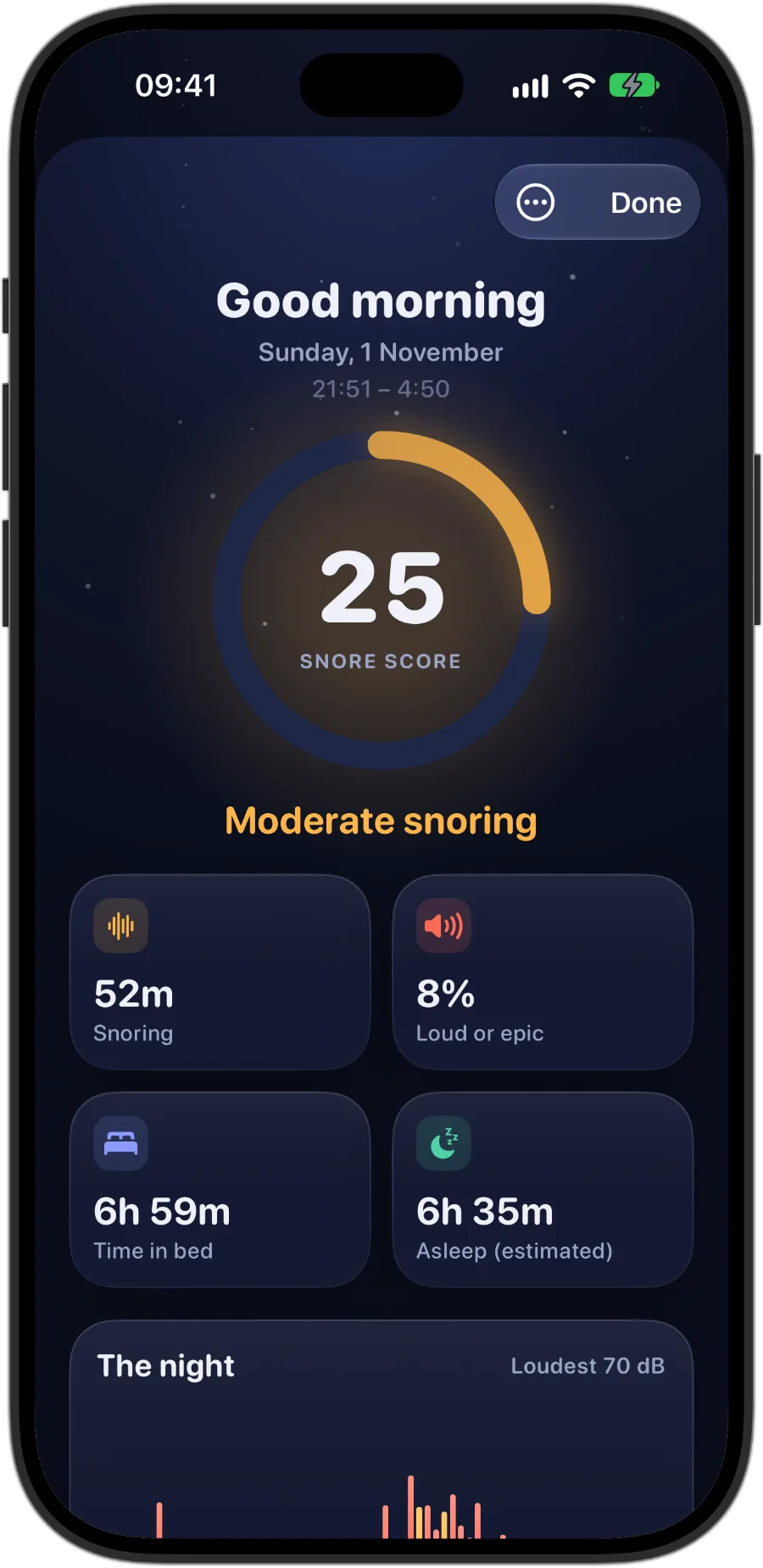
This page is general information, not medical advice. Snores is not a medical device and does not diagnose sleep apnea or any other condition. If you are worried about your sleep or your breathing, talk to a doctor.