REMEDIES
Sleeping on your side
For many snorers, the simplest remedy of all. The hard part is staying there.
- Best for
- People who snore mostly on their back
- Evidence
- Moderate: sleep lab studies and trials in sleep apnea
- Cost
- Free, or the price of a pillow
- Time to work
- The first night
Why your back makes snoring worse
Lying on your back, gravity pulls the tongue and soft palate towards the back of the throat, narrowing the airway. On your side, they fall to the side instead. The effect is clearest in people who snore without sleep apnea: in the study of 72 snorers, most of them snored less, and more quietly, on their side, while people with sleep apnea showed mixed results 1.
In sleep apnea, position matters too. In 30 men evaluated for sleep apnea, breathing pauses were twice as frequent on the back as on the side, and five of them had normal breathing on their side 3. In a larger study of 574 people with sleep apnea, more than half had at least twice as many breathing events on their back; they tended to be younger and slimmer 4.
How to stay on your side
What helps
- A pillow behind your back, or a long body pillow to hug, so rolling back is less comfortable.
- A positional pillow or wedge designed to keep you on your side.
- A backpack or a T-shirt with a soft ball sewn into the back. The classic “tennis ball” trick works, but few people keep it up, mostly because it is uncomfortable 2.
- A sleep position trainer: a small device worn across the chest that vibrates gently when you lie on your back. In a trial in people with positional sleep apnea, it worked as well as an oral appliance 5.
- Raise the head of the bed if you can't stay off your back at all. See raising the head of the bed.
Key study
How long people stick with the tennis ball
- 67 patients
- Positional sleep apnea
- About 2.5 years later
Patients who had been told to sleep with a tennis ball in the back of their nightwear were asked about it 2.5 years later on average. Only 6% were still using it. Another 13% had learned to stay off their back without it, and the rest were neither using it nor avoiding their back, most because it was too uncomfortable.
Good for
- Free and safe for almost everyone
- Works from the first night if it suits you
- Easy to combine with other remedies
Watch out for
- Hard to keep up all night
- Less effective for some people with sleep apnea 1
- Shoulder or hip discomfort for some
Does sleeping on your side stop snoring?
For many people who snore mainly on their back, it reduces snoring a lot 1. It helps less if your snoring has other causes, such as a blocked nose.
Which side is better for snoring, left or right?
There is no clear evidence that one side is better than the other for snoring. Choose whichever is more comfortable.
Why do I snore even on my side?
Your snoring may come from your nose, alcohol or the shape of your airway rather than your position. Some people with sleep apnea also snore on their side 1.
Does the tennis ball trick work?
It can, but most people stop using it because it is uncomfortable 2. A body pillow or positional device may be easier to keep up.
Sources
- Nakano H, Ikeda T, Hayashi M, Ohshima E, Onizuka A. Effects of body position on snoring in apneic and nonapneic snorers. Sleep. 2003;26(2):169-172. doi.org/10.1093/sleep/26.2.169
- Bignold JJ, Deans-Costi G, Goldsworthy MR, et al. Poor long-term patient compliance with the tennis ball technique for treating positional obstructive sleep apnea. J Clin Sleep Med. 2009;5(5):428-430. doi.org/10.5664/jcsm.27597
- Cartwright RD. Effect of sleep position on sleep apnea severity. Sleep. 1984;7(2):110-114. doi.org/10.1093/sleep/7.2.110
- Oksenberg A, Silverberg DS, Arons E, Radwan H. Positional vs nonpositional obstructive sleep apnea patients: anthropomorphic, nocturnal polysomnographic, and multiple sleep latency test data. Chest. 1997;112(3):629-639. doi.org/10.1378/chest.112.3.629
- Benoist L, de Ruiter M, de Lange J, de Vries N. A randomized, controlled trial of positional therapy versus oral appliance therapy for position-dependent sleep apnea. Sleep Med. 2017;34:109-117. doi.org/10.1016/j.sleep.2017.01.024
COMING SOON
Find out
how you snore.
Snores listens through the night on your iPhone and shows you in the morning how much and how loudly you snored, with clips of the loudest moments. Tag what you tried and see what goes with quieter nights. The sound stays on your iPhone.
Meet Snores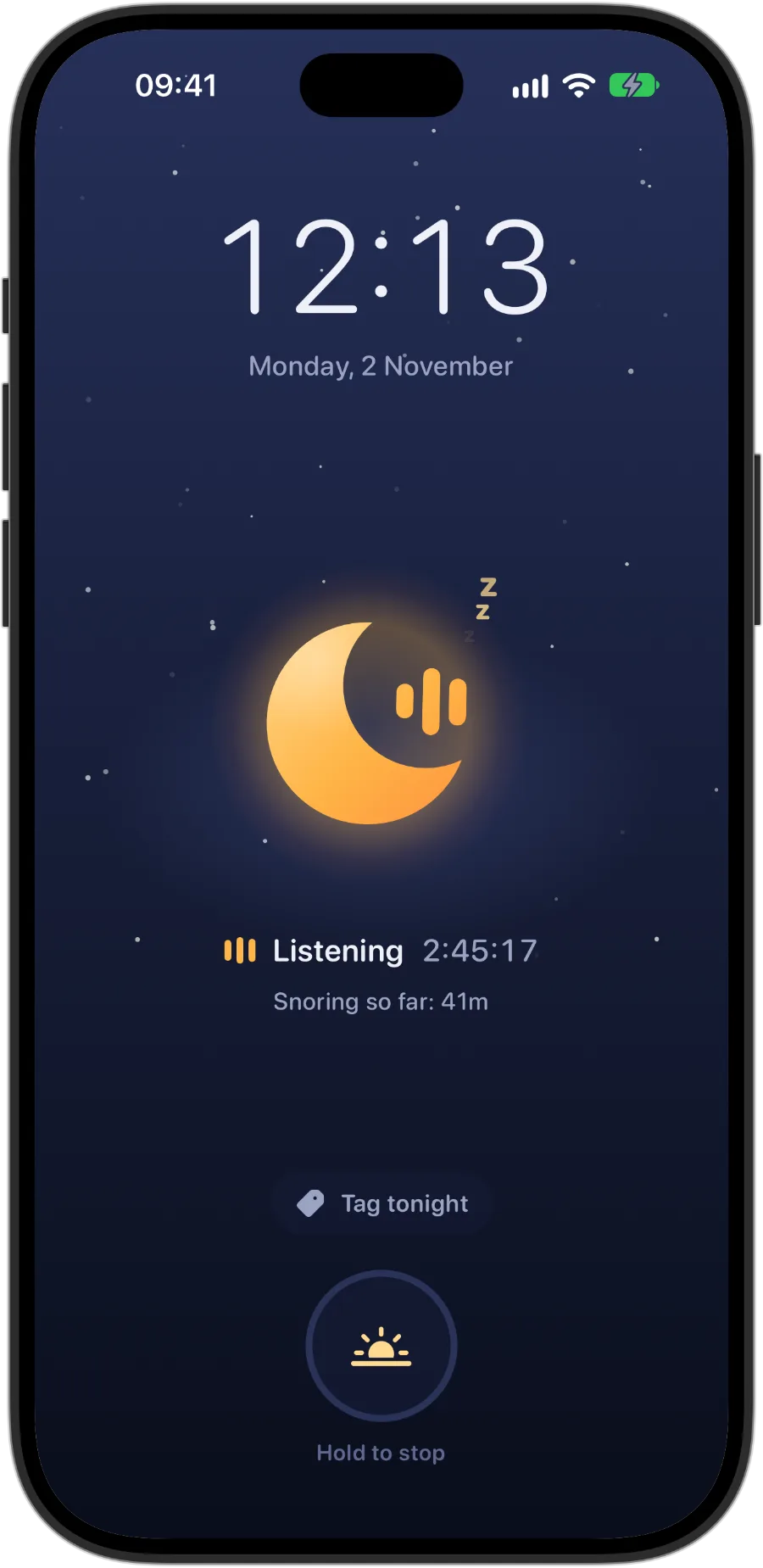
This page is general information, not medical advice. Snores is not a medical device and does not diagnose sleep apnea or any other condition. If you are worried about your sleep or your breathing, talk to a doctor.