REMEDIES
Mouth and throat exercises
Daily exercises for the tongue, soft palate and throat. Small trials found they roughly halved snoring.
- Best for
- Anyone willing to practise every day
- Evidence
- Moderate: small randomized trials and reviews
- Cost
- Free
- Time to work
- Several weeks to three months
Why exercise your throat?
Snoring happens when the muscles that hold the airway open relax in sleep. The idea behind these exercises, which come from speech therapy, is that stronger, better-toned muscles in the tongue, the soft palate and the walls of the throat keep the airway more open at night.
What the research found
Key study
Throat exercises for snoring, a randomized trial
- 39 adults
- Snoring or mild to moderate sleep apnea
- 3 months
Adults who came to a sleep clinic because of snoring were randomly assigned to daily mouth and throat exercises or to a comparison treatment of nasal strips and deep breathing exercises. After three months, the exercise group's snore index (snores louder than 36 dB per hour) fell from a median of 99.5 to 48.2 and the total power of their snoring roughly halved. The comparison group didn't change.
A systematic review gathered nine studies with 211 adults. After exercise programs, snoring loudness on a 0 to 10 scale fell by 51%, from 8.2 to 4.0, and the time spent snoring in sleep studies fell by 31%, from 26% to 18% of the night 2. An earlier review of exercises for sleep apnea found that they roughly halved the apnea-hypopnea index in adults and reduced snoring and sleepiness 3.
In an earlier trial in moderate sleep apnea, 30 minutes of exercises a day for three months reduced snoring frequency and loudness, daytime sleepiness and the severity of sleep apnea, and even neck circumference 4. Playing the didgeridoo, which trains the upper airway in a similar way, improved daytime sleepiness and the partners' rating of sleep disturbance in a small trial 5.
Eight exercises
These are the eight exercises in Snores' daily routine, adapted from the programs used in the studies. The first three are the free routine in the app. Do them sitting up, slowly and with control. Stop if anything hurts.
Tongue slide
- Tongue and soft palate
- 10 times
- Put the tip of your tongue just behind your top front teeth.
- Slide it slowly back along the roof of your mouth, as far as is comfortable.
- Bring it forward again and repeat.
Tongue press up
- Tongue
- 8 times
- Relax your jaw, with your lips gently apart.
- Press your whole tongue flat against the roof of your mouth.
- Hold it there for 3 seconds, pressing firmly, then relax and repeat.
Soft palate “ah”
- Soft palate and throat
- 8 times
- Open your mouth wide.
- Say “ah” out loud, firmly, and feel the back of the roof of your mouth lift.
- Rest for a moment and repeat.
Tongue push down
- Back of the tongue
- 8 times
- Touch the tip of your tongue to your bottom front teeth.
- Push the back of your tongue down against the floor of your mouth.
- Hold for 3 seconds, then relax.
Cheek hook
- Cheeks and lips
- 5 times each side
- Wash your hands first.
- With a clean finger, gently hook the inside of one cheek and pull it outward.
- Pull your cheek back in against your finger, using your cheek muscles, then switch sides.
Jaw slide
- Jaw
- 5 times each side
- Open your mouth slightly and relax your face.
- Slide your lower jaw slowly to the left and hold for a moment.
- Bring it back to the center, then slide it to the right.
Vowel singing
- Lips, tongue and throat
- 3 rounds
- Sit up and take a breath.
- Say each vowel, A, E, I, O, U, out loud, slowly and clearly.
- Make each mouth shape as big as you can.
Chewing with closed lips
- Jaw and lips
- 3 rounds, 5 seconds each side
- Close your lips gently.
- Chew slowly as if you had food in your mouth, on one side and then the other.
- Keep your lips closed. At meals, try chewing this way on both sides.
Making it a habit
Getting results
Do throat exercises really stop snoring?
They reduced snoring by about a third to a half in studies 2,1. They rarely stop it completely, and they need daily practice.
How long do snoring exercises take to work?
Most studies ran for about three months of daily practice 1,4. Some people notice changes sooner.
Does singing help snoring?
Exercises that train the throat seem to help, and singing works some of the same muscles. Playing the didgeridoo improved sleep outcomes in a small trial 5.
Sources
- Ieto V, Kayamori F, Montes MI, et al. Effects of oropharyngeal exercises on snoring: a randomized trial. Chest. 2015;148(3):683-691. doi.org/10.1378/chest.14-2953
- Camacho M, Guilleminault C, Wei JM, et al. Oropharyngeal and tongue exercises (myofunctional therapy) for snoring: a systematic review and meta-analysis. Eur Arch Otorhinolaryngol. 2018;275(4):849-855. doi.org/10.1007/s00405-017-4848-5
- Camacho M, Certal V, Abdullatif J, et al. Myofunctional therapy to treat obstructive sleep apnea: a systematic review and meta-analysis. Sleep. 2015;38(5):669-675. doi.org/10.5665/sleep.4652
- Guimarães KC, Drager LF, Genta PR, Marcondes BF, Lorenzi-Filho G. Effects of oropharyngeal exercises on patients with moderate obstructive sleep apnea syndrome. Am J Respir Crit Care Med. 2009;179(10):962-966. doi.org/10.1164/rccm.200806-981OC
- Puhan MA, Suarez A, Lo Cascio C, et al. Didgeridoo playing as alternative treatment for obstructive sleep apnoea syndrome: randomised controlled trial. BMJ. 2006;332(7536):266-270. doi.org/10.1136/bmj.38705.470590.55
COMING SOON
Find out
how you snore.
Snores listens through the night on your iPhone and shows you in the morning how much and how loudly you snored, with clips of the loudest moments. Tag what you tried and see what goes with quieter nights. The sound stays on your iPhone.
Meet Snores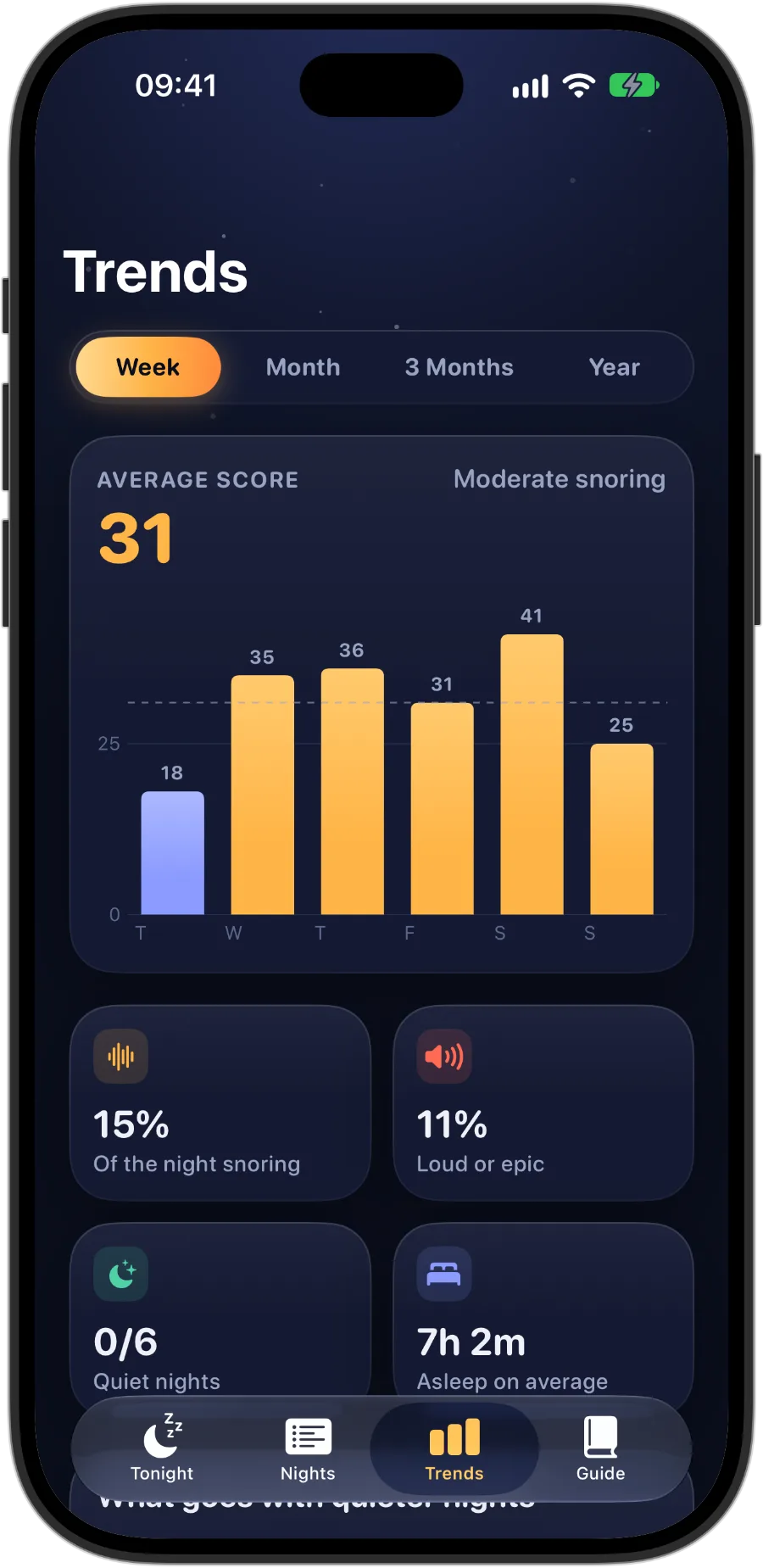
This page is general information, not medical advice. Snores is not a medical device and does not diagnose sleep apnea or any other condition. If you are worried about your sleep or your breathing, talk to a doctor.