SNORING
Is snoring bad for you?
The honest answer: simple snoring is mostly harmless to you, less so to your partner, and sleep apnea is a different story.
Simple snoring and your health
In the Busselton Health Study in Western Australia, 380 people had their snoring measured at home in 1990 and were followed for 17 years. They snored for about a third of the night on average. Snoring, measured in any way, was not linked to death, heart disease or stroke, with or without taking sleep apnea and other risk factors into account 1.
Key study
Snoring and the heart over 17 years
- 380 adults
- Measured at home
- 17 years of follow-up
People in a community study had their snoring measured for a night with a home device and were followed through hospital and death records until 2007. There were 46 deaths, 68 cardiovascular events and 24 strokes. No measure of snoring was associated with any of them, before or after adjusting for sleep apnea and other risk factors.
One study can't settle everything, and researchers still debate whether very heavy snoring itself strains the arteries of the neck. But the clearer risks belong to sleep apnea.
When snoring is a sign of sleep apnea
In a Spanish study, more than 1,600 men were followed for about 10 years. Men with untreated severe obstructive sleep apnea had about three times the risk of fatal and non-fatal heart attacks and strokes of healthy men. Simple snorers had rates close to healthy men, and men whose sleep apnea was treated with CPAP had their risk brought down too 2. The study was observational, so it shows a link rather than proof, but it is one reason doctors take loud snoring with pauses seriously.
Sleep apnea also causes daytime sleepiness. In the UK survey, both snoring and breathing pauses went with drowsiness while driving 4. See snoring or sleep apnea? for the signs.
Snoring and the person beside you
Snoring may bother the bed partner more than the snorer. When ten men with snoring and suspected sleep apnea were treated with CPAP halfway through a night in the sleep lab, their wives woke up far less often (21 times an hour before, 12 after) and spent more of the night asleep (74% before, 87% after). The researchers worked out that this would add about an hour of sleep a night 3. See sleeping with a snorer.
Other things snoring can do
- Dry mouth and sore throat in the morning, from breathing through the mouth.
- Broken sleep for the snorer, especially if snoring comes with breathing pauses.
- Strain on relationships, including sleeping in separate rooms.
- In children, snoring with other signs of disturbed breathing has been linked with behavior problems 5. See snoring in children.
Can snoring damage your health?
Simple snoring is not clearly linked to heart disease or stroke 1. The real risks come from sleep apnea, so it matters to know which one you have.
Can snoring cause high blood pressure?
Sleep apnea is linked with high blood pressure, and guidelines suggest CPAP for people who have both 6. Simple snoring on its own has not been shown to cause it.
Is snoring bad for your partner?
It can be. In one study, removing the snoring gave partners about an hour more sleep a night 3.
Should I worry if I snore every night?
Not necessarily. Many people snore every night without sleep apnea. Worry less about how often and more about pauses, gasping and daytime sleepiness. See is it normal to snore every night?.
Sources
- Marshall NS, Wong KK, Cullen SR, Knuiman MW, Grunstein RR. Snoring is not associated with all-cause mortality, incident cardiovascular disease, or stroke in the Busselton Health Study. Sleep. 2012;35(9):1235-1240. doi.org/10.5665/sleep.2076
- Marin JM, Carrizo SJ, Vicente E, Agusti AG. Long-term cardiovascular outcomes in men with obstructive sleep apnoea-hypopnoea with or without treatment with continuous positive airway pressure: an observational study. Lancet. 2005;365(9464):1046-1053. doi.org/10.1016/S0140-6736(05)71141-7
- Beninati W, Harris CD, Herold DL, Shepard JW Jr. The effect of snoring and obstructive sleep apnea on the sleep quality of bed partners. Mayo Clin Proc. 1999;74(10):955-958. doi.org/10.4065/74.10.955
- Ohayon MM, Guilleminault C, Priest RG, Caulet M. Snoring and breathing pauses during sleep: telephone interview survey of a United Kingdom population sample. BMJ. 1997;314(7084):860-863. doi.org/10.1136/bmj.314.7084.860
- Bonuck K, Freeman K, Chervin RD, Xu L. Sleep-disordered breathing in a population-based cohort: behavioral outcomes at 4 and 7 years. Pediatrics. 2012;129(4):e857-e865. doi.org/10.1542/peds.2011-1402
- Patil SP, Ayappa IA, Caples SM, Kimoff RJ, Patel SR, Harrod CG. Treatment of adult obstructive sleep apnea with positive airway pressure: an American Academy of Sleep Medicine clinical practice guideline. J Clin Sleep Med. 2019;15(2):335-343. doi.org/10.5664/jcsm.7640
COMING SOON
Find out
how you snore.
Snores listens through the night on your iPhone and shows you in the morning how much and how loudly you snored, with clips of the loudest moments. Tag what you tried and see what goes with quieter nights. The sound stays on your iPhone.
Meet Snores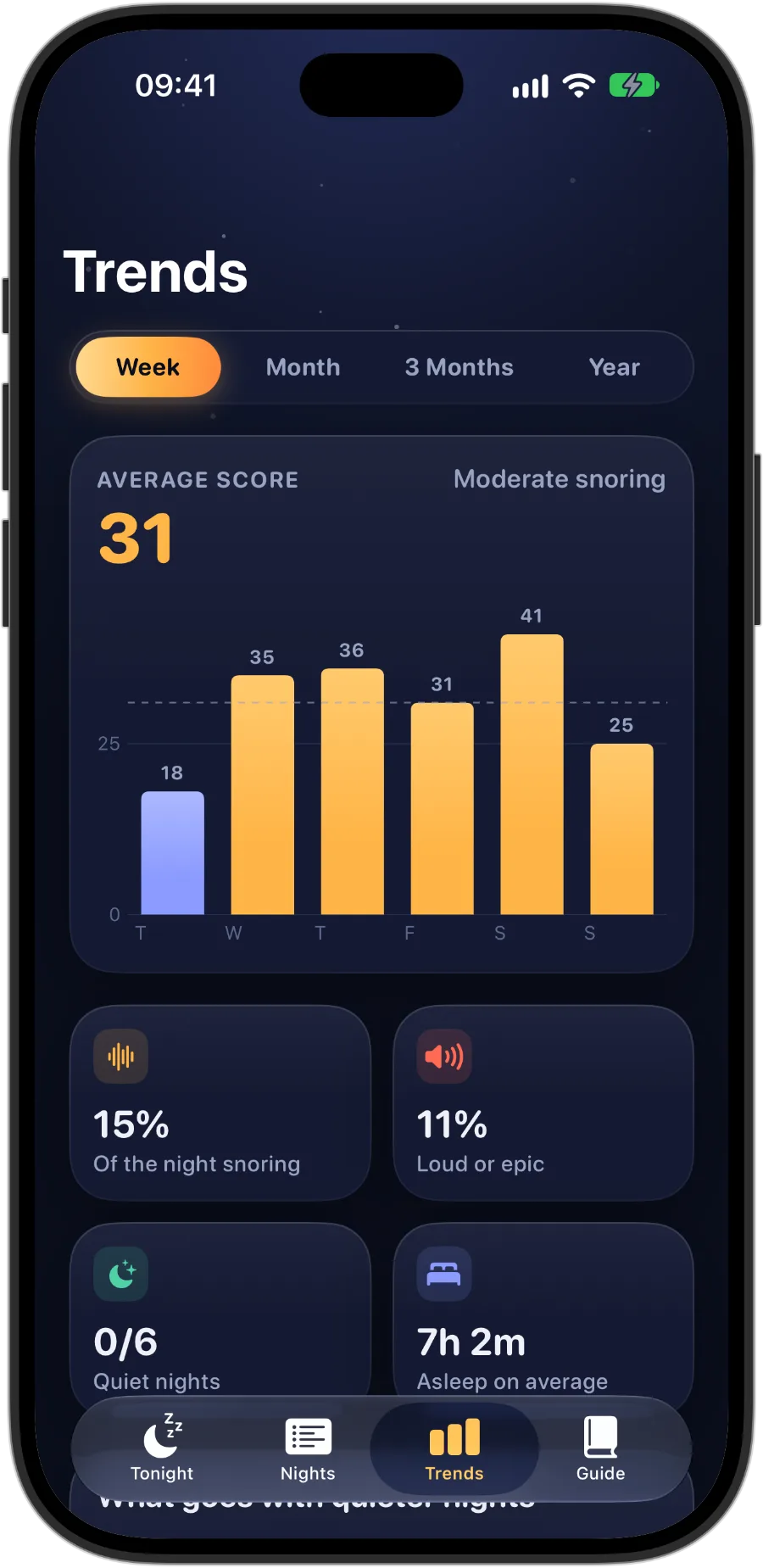
This page is general information, not medical advice. Snores is not a medical device and does not diagnose sleep apnea or any other condition. If you are worried about your sleep or your breathing, talk to a doctor.