
SNORING
Snoring in children
Snoring with a cold is normal. Snoring on most nights is worth a word with your child's doctor.
How common it is
A review of studies on children found that, by any definition, about 7.45% of children snore according to their parents, 1.5 to 6% snore “always”, and 1 to 4% have obstructive sleep apnea. It is more common in boys and in children who are heavier 1.
Why children snore
- Large tonsils and adenoids, the most common cause. They are at their biggest relative to the airway between about 2 and 6 years old.
- A blocked nose from colds, allergies or enlarged adenoids.
- Excess weight, increasingly common 1.
- Less often, the shape of the face or jaw, or conditions that affect muscle tone.
Signs to tell the doctor about
Children with sleep apnea don't always seem sleepy. Instead, broken sleep can show as restlessness, irritability or trouble concentrating. Look out for:
- snoring on most nights, not only with a cold;
- pauses in breathing, gasping or snorting;
- breathing through the mouth, day and night;
- restless sleep, unusual sleeping positions such as the neck stretched back, or sweating at night;
- bedwetting that comes back after the child was dry;
- hyperactivity, irritability or problems with attention at school.
Key study
Snoring in early childhood and later behavior
- Over 9,000 children
- UK, from birth
- Parents reported symptoms
In a long-term study of children in the Avon area of England, parents reported snoring, mouth breathing and pauses in breathing from 6 months to almost 6 years. Children with these symptoms had about 20 to 100% higher odds of behavior problems such as hyperactivity at ages 4 and 7, even when their symptoms had faded.
What the doctor may do
The American Academy of Pediatrics recommends that children and teenagers who snore and have signs of sleep apnea have a sleep test, and that removing enlarged tonsils and adenoids be the first treatment when they are the cause. Nasal steroid sprays are an option for mild cases, and weight loss helps children who are overweight 2.
In a trial of 464 children aged 5 to 9 with sleep apnea, removing the tonsils and adenoids didn't improve attention test scores more than watchful waiting, but it did improve behavior, quality of life and symptoms, and normalized sleep tests in 79% of children compared with 46% 3.
Is it normal for my child to snore?
Occasional snoring with a cold is normal. Snoring on most nights isn't, and is worth mentioning to your child's doctor 2.
Can snoring affect my child's behavior?
Disturbed breathing in sleep has been linked with hyperactivity and other behavior problems in large studies 4. Treatment improved behavior in a large trial 3.
Will my child grow out of snoring?
Many do, as the airway grows and the tonsils shrink. But snoring with signs of sleep apnea should be checked rather than waited out.
Why does my toddler snore?
Tonsils and adenoids are largest relative to the airway in young children, and colds are frequent. If it happens most nights, mention it to the doctor.
Sources
- Lumeng JC, Chervin RD. Epidemiology of pediatric obstructive sleep apnea. Proc Am Thorac Soc. 2008;5(2):242-252. doi.org/10.1513/pats.200708-135MG
- Marcus CL, Brooks LJ, Draper KA, et al. Diagnosis and management of childhood obstructive sleep apnea syndrome. Pediatrics. 2012;130(3):576-584. doi.org/10.1542/peds.2012-1671
- Marcus CL, Moore RH, Rosen CL, et al. A randomized trial of adenotonsillectomy for childhood sleep apnea. N Engl J Med. 2013;368(25):2366-2376. doi.org/10.1056/NEJMoa1215881
- Bonuck K, Freeman K, Chervin RD, Xu L. Sleep-disordered breathing in a population-based cohort: behavioral outcomes at 4 and 7 years. Pediatrics. 2012;129(4):e857-e865. doi.org/10.1542/peds.2011-1402
COMING SOON
Find out
how you snore.
Snores listens through the night on your iPhone and shows you in the morning how much and how loudly you snored, with clips of the loudest moments. Tag what you tried and see what goes with quieter nights. The sound stays on your iPhone.
Meet Snores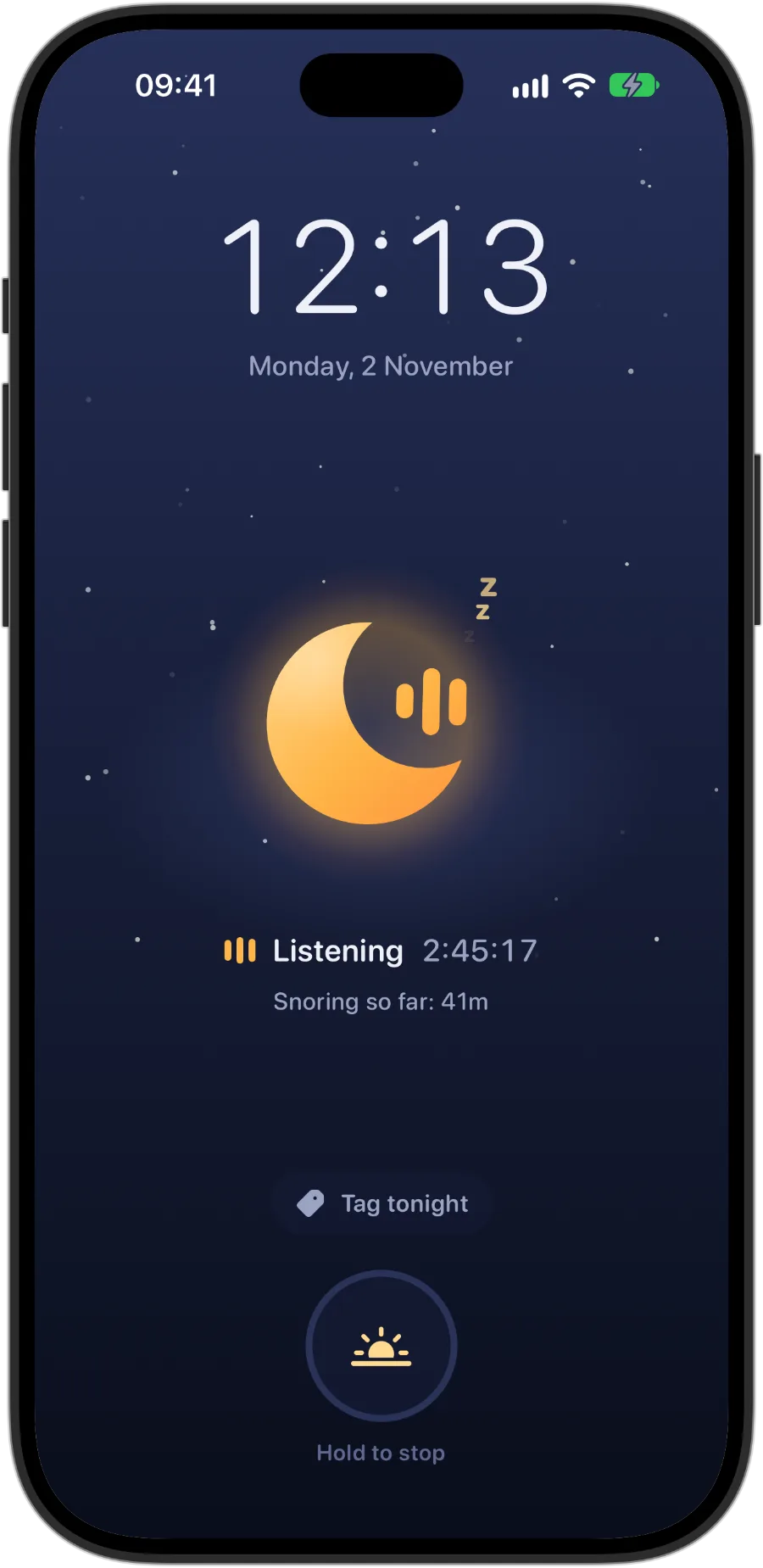
This page is general information, not medical advice. Snores is not a medical device and does not diagnose sleep apnea or any other condition. If you are worried about your sleep or your breathing, talk to a doctor.