SNORING
Why we snore
What actually makes the sound, and why your sleeping position, your nose and your evening all play a part.
What happens in your throat
Behind your nose and mouth is a soft, flexible tube: the pharynx. Unlike your windpipe, it has no rigid rings of cartilage to keep it open. While you are awake, muscles in the tongue, the soft palate and the walls of the throat hold it open. As you fall asleep, those muscles relax and the tube becomes floppier and narrower.
Air moving through a narrow, floppy tube speeds up and pulls the soft walls inwards. The soft palate, the uvula and the base of the tongue start to vibrate. That vibration is the snore. Researchers who study its sound describe it as a low-pitched tone, mostly under 500 Hz, that comes from the soft palate, with noisier sounds when other parts of the throat vibrate 1.
- Soft palate
- The soft back part of the roof of your mouth. Its flutter makes most of the classic snoring sound.
- Uvula
- The small piece of tissue that hangs down at the back of the soft palate.
- Pharynx
- The soft tube behind the nose and mouth that air passes through. It narrows when its muscles relax in sleep.
- Primary snoring
- Snoring without pauses in breathing or other signs of sleep apnea. Sometimes called simple snoring.
Why some people snore and others don't
Snoring is common. In a telephone survey of 4,972 people in the United Kingdom, 40% said they snored regularly. Regular snoring was more common in men, in people aged 25 or more, in people with obesity, in smokers and in people who drank a lot of caffeine 2. Reviews put the share of adults who snore at somewhere between 20% and 40%, depending on how snoring is defined 1.
Some of the reasons are built in. A narrower jaw, large tonsils, a long soft palate or a large tongue leave less room for air. Others change over a lifetime: extra weight around the neck, the muscle tone that softens with age, hormones around pregnancy and menopause. And some change from night to night.
What makes snoring louder tonight
- Sleeping on your back. Gravity pulls the tongue and soft palate back towards the throat. In a sleep laboratory study of 72 habitual snorers, most of those without sleep apnea snored less, and more quietly, on their side 3. See side sleeping.
- Alcohol. It relaxes the throat muscles further. In a classic study, alcohol before bed turned plain snoring into pauses in breathing in the first hour of sleep 4. See snoring and alcohol.
- A blocked nose. When the nose is blocked, you breathe harder and often through your mouth. People with frequent night-time nasal symptoms were more likely to be habitual snorers 5. See a blocked nose and allergies.
- Deep sleep. Snoring tends to be heavier in deep non-REM sleep and lighter in REM sleep 3.
- Being very tired, sleeping pills and some sedatives, which relax the muscles more. Never stop a prescribed medicine without talking to your doctor.
Is it snoring, or something more?
Most snoring is just noise. But loud snoring is also the most common sign of obstructive sleep apnea, in which the airway closes completely for a few seconds again and again. The clues are pauses in breathing, gasping or choking, and feeling very sleepy in the day. Snoring or sleep apnea? explains the difference.
Myth Only overweight men snore.
Fact Men snore more often, but women, children and slim people snore too. Weight is only one of many causes 2.
Myth Snoring means you are sleeping deeply and well.
Fact Snoring is often heavier in deep sleep 3, but it says nothing about how restful your night was. Loud snoring with pauses can mean broken sleep.
Myth You can't do anything about snoring.
Fact Many causes can be changed, from sleeping position to alcohol and a blocked nose. See how to stop snoring.
Why do I snore when I sleep on my back?
On your back, gravity pulls the tongue and soft palate towards the back of the throat, narrowing the airway. Many people who snore, especially those without sleep apnea, snore less on their side 3.
Why do I snore some nights and not others?
Snoring depends on your position, sleep stage, whether your nose is clear and what you did in the evening, such as drinking alcohol. All of these change from night to night 1.
Can you snore through your nose?
Yes. Snoring can come from the nose, the soft palate or the base of the tongue, and many people snore with the mouth closed. Mouth snoring and nose snoring often need different remedies.
Is snoring hereditary?
Partly. The shape of your jaw, airway and face runs in families, and so does the tendency to gain weight. But many of the things that make snoring louder, like alcohol and sleeping position, are habits rather than genes.
Sources
- Pevernagie D, Aarts RM, De Meyer M. The acoustics of snoring. Sleep Med Rev. 2010;14(2):131-144. doi.org/10.1016/j.smrv.2009.06.002
- Ohayon MM, Guilleminault C, Priest RG, Caulet M. Snoring and breathing pauses during sleep: telephone interview survey of a United Kingdom population sample. BMJ. 1997;314(7084):860-863. doi.org/10.1136/bmj.314.7084.860
- Nakano H, Ikeda T, Hayashi M, Ohshima E, Onizuka A. Effects of body position on snoring in apneic and nonapneic snorers. Sleep. 2003;26(2):169-172. doi.org/10.1093/sleep/26.2.169
- Issa FG, Sullivan CE. Alcohol, snoring and sleep apnea. J Neurol Neurosurg Psychiatry. 1982;45(4):353-359. doi.org/10.1136/jnnp.45.4.353
- Young T, Finn L, Kim H. Nasal obstruction as a risk factor for sleep-disordered breathing. J Allergy Clin Immunol. 1997;99(2):S757-S762. doi.org/10.1016/S0091-6749(97)70124-6
COMING SOON
Find out
how you snore.
Snores listens through the night on your iPhone and shows you in the morning how much and how loudly you snored, with clips of the loudest moments. Tag what you tried and see what goes with quieter nights. The sound stays on your iPhone.
Meet Snores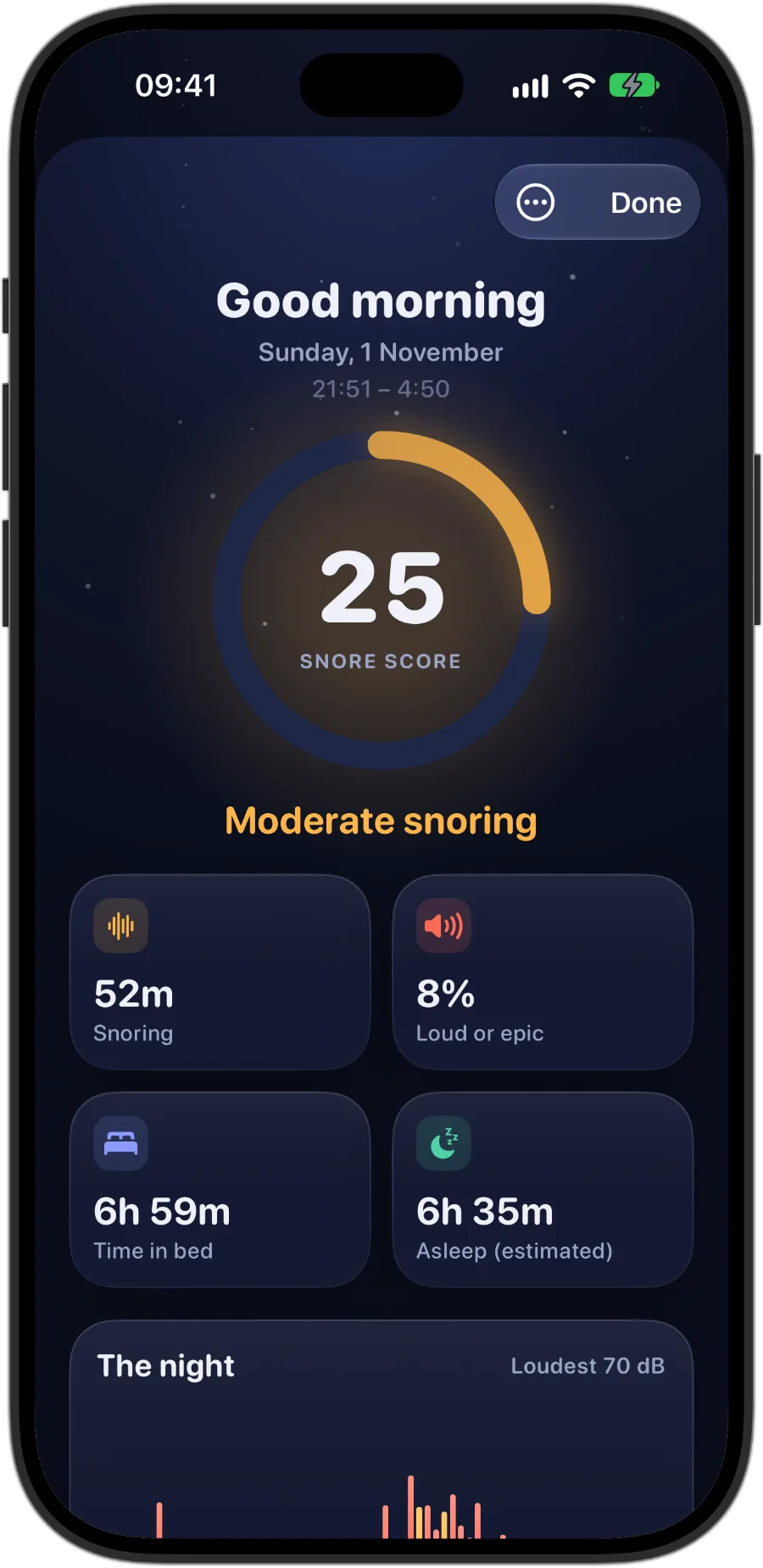
This page is general information, not medical advice. Snores is not a medical device and does not diagnose sleep apnea or any other condition. If you are worried about your sleep or your breathing, talk to a doctor.