REMEDIES
Nasal strips and dilators
They open the nose. That helps some snorers a lot and others not at all.
- Best for
- Snoring from a narrow or stuffy nose
- Evidence
- Weak to moderate
- Cost
- Low, sold without a prescription in many countries
- Time to work
- The first night
How they work
The narrowest part of the nose is just inside the nostrils. If it is narrow or collapses as you breathe in, you breathe harder and often switch to your mouth, and both make the soft tissue of the throat more likely to vibrate.
- External strips stick across the bridge of the nose and gently pull the sides of the nostrils outwards, like a spring.
- Internal dilators are small, soft cones or clips that sit just inside the nostrils and hold them open from the inside.
What the research found
Key study
A nostril dilator for six months
- 42 men
- Heavy snorers
- 6 months
Men who snored heavily used a nostril dilator for six months. Their partners rated their snoring on a scale of 0 to 100 and the men rated their morning tiredness. Snoring fell significantly at one month and at six months, less snoring went with less morning tiredness, and 60% were still using the dilator after six months. There was no comparison group.
Löth & Petruson · Arch Otolaryngol Head Neck Surg · 1996 Source 1
In people with sleep apnea, the picture is different. A review of 14 studies found that nasal dilators made breathing through the nose easier, but didn't change the number of breathing pauses, oxygen levels or the snoring index 2. And in a trial where nasal strips were the comparison treatment, snoring didn't change over three months of using them alongside breathing exercises 3.
Who they suit
Good for
- Snoring that is worse with a stuffy nose
- Nostrils that collapse when you breathe in deeply
- Trying a cheap, safe remedy first
Watch out for
- Skin irritation from the adhesive
- Internal dilators can feel odd at first
- Not a treatment for sleep apnea 2
Using a nasal strip
- Wash and dry the nose so the strip sticks.
- Place it on the lower part of the bridge, just above the flare of the nostrils.
- Remove it slowly in the morning, ideally after washing your face.
- Use it for a week, and compare with nights without it.
Do nasal strips really work for snoring?
For some people. They helped heavy snorers in one study 1, but not people with sleep apnea 2. They work best when the nose is the problem.
Are nasal strips or dilators better?
Both open the nostrils. In the review, internal dilators had a slightly bigger effect on breathing pauses than strips 2. Comfort decides for most people.
Can you use nasal strips every night?
Yes, most people can. Stop if the skin becomes sore.
Do nasal strips help with mouth breathing?
If you breathe through your mouth because your nose is narrow, opening it may help you breathe through your nose. See mouth taping for why clearing the nose comes first.
Sources
- Löth S, Petruson B. Improved nasal breathing reduces snoring and morning tiredness: a 6-month follow-up study. Arch Otolaryngol Head Neck Surg. 1996;122(12):1337-1340. doi.org/10.1001/archotol.1996.01890240045010
- Camacho M, Malu OO, Kram YA, et al. Nasal dilators (Breathe Right strips and NoZovent) for snoring and OSA: a systematic review and meta-analysis. Pulm Med. 2016;2016:4841310. doi.org/10.1155/2016/4841310
- Ieto V, Kayamori F, Montes MI, et al. Effects of oropharyngeal exercises on snoring: a randomized trial. Chest. 2015;148(3):683-691. doi.org/10.1378/chest.14-2953
COMING SOON
Find out
how you snore.
Snores listens through the night on your iPhone and shows you in the morning how much and how loudly you snored, with clips of the loudest moments. Tag what you tried and see what goes with quieter nights. The sound stays on your iPhone.
Meet Snores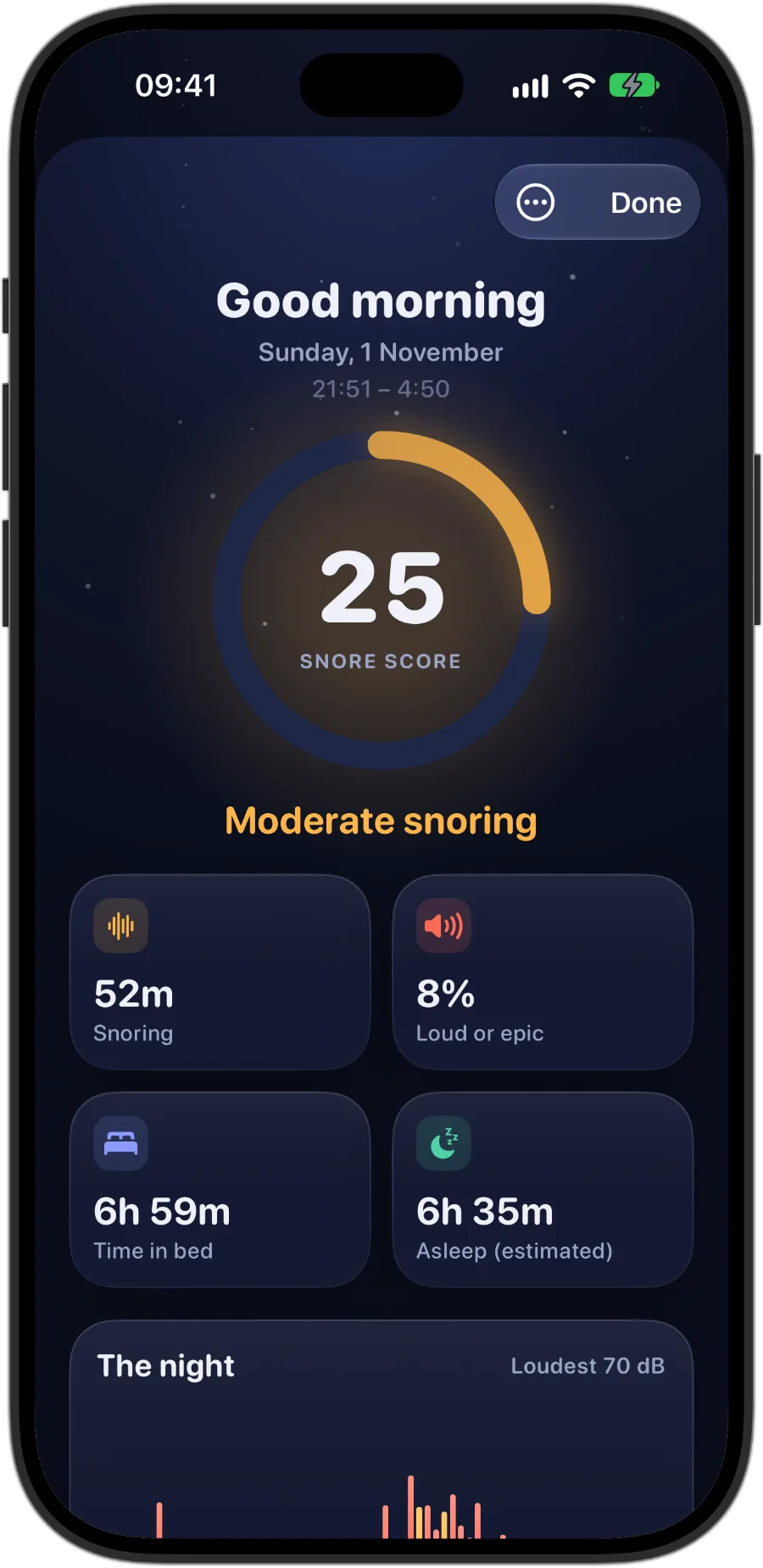
This page is general information, not medical advice. Snores is not a medical device and does not diagnose sleep apnea or any other condition. If you are worried about your sleep or your breathing, talk to a doctor.